

Returns and post-sale discounts
How to adjust a sell order after it was finalized — taking products back or forgiving part of the amount — and what that does to your stock, the debt, the wallet and the money you return.
A sell order is finished, and then something changes: the customer brings a product back, or you agree to take something off what they still owe. Control Total handles both without editing the original document. It records an adjustment against it, and the sell order keeps its history intact — what was sold, what was paid, and what was given back.
There are two kinds of adjustment, and they answer to different permissions, so one person can be allowed to take returns without being allowed to forgive debt.
| Adjustment | What it is for |
|---|---|
| Register return | The customer gives products back |
| Apply post-sale discount | You reduce what the customer still owes, without any product moving |
Both are offered from the sell order's screen, in the side panel, and both need the order to be in its created state. A cancelled order cannot be adjusted, and neither can a draft. See Create a sell order.
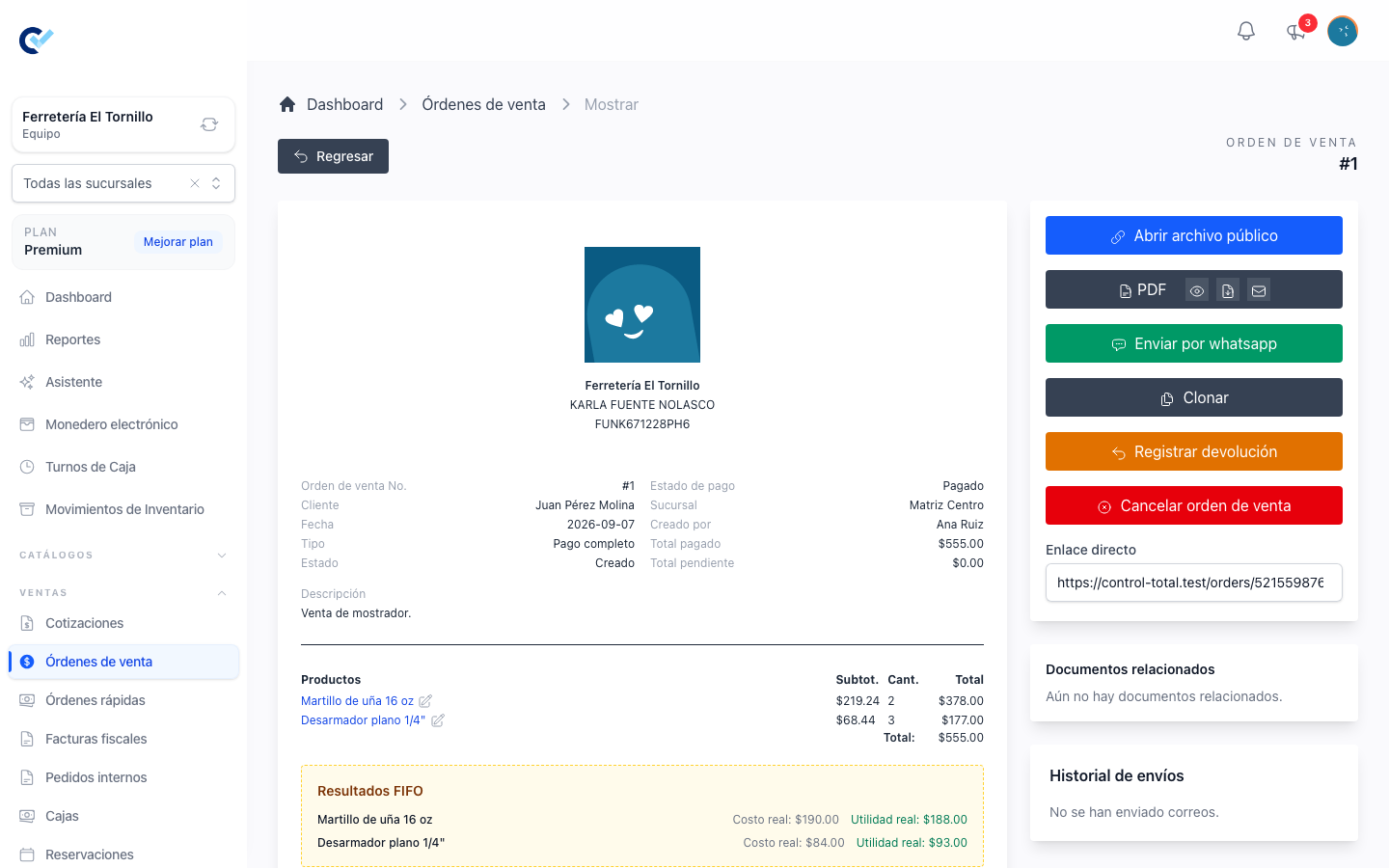
Register a return
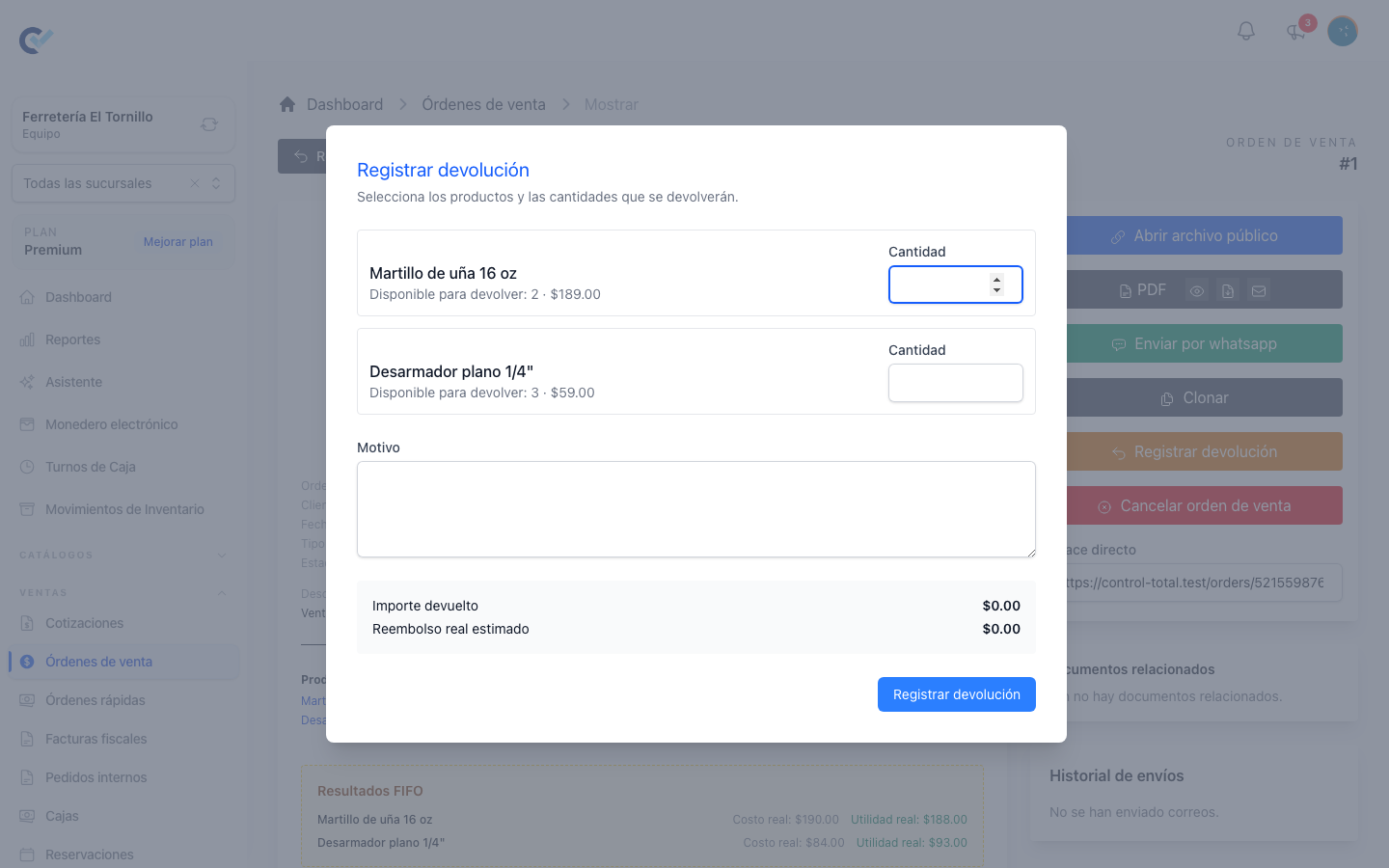
Register return opens a form listing every product on the order. Each line tells you how much is Available to return — the quantity sold, less whatever has already come back — and the unit price it was sold at. Type the quantity for each product being returned; leave the rest empty. You can return part of one line, all of one line, or the whole order.
Then:
- Disposition, which appears when one of the products you are returning is tracked in your inventory. Choose Restockable (returns to inventory) when the product can be sold again, or Damaged (does not return to inventory) when it cannot. Products that are not tracked are unaffected either way.
- Reason, which is required. It is what you and your colleagues will read months later in the order's history, so write something a stranger would understand.
As you type quantities, the form shows two figures:
- Return amount — what the returned products are worth.
- Estimated real refund — how much of that has to come back out of the till, once the outstanding balance has absorbed its part.
If that second figure is above zero, the form asks for a Refund payment method, any extra reference for it, and the date of the refund. It suggests the method the customer last paid with.
Press Register return and the adjustment is recorded.
What the return does
The amount of the return is applied in a fixed order, and understanding that order is the whole of it:
- The wallet comes back first. If the customer paid part of this order with their electronic wallet balance, the return puts that share back into their wallet, in proportion to how much of the order has now been returned. See Register a payment.
- Then the debt goes down. Whatever is left of the return amount reduces what the customer still owes on this order, up to the whole outstanding balance.
- Only then is money refunded. If there is still something left over after the debt has gone to zero, that is what leaves the till — and never more than the customer actually paid. It is registered as a refund on the order, with the method and date you entered, so the day's cash matches. See Cashier shifts.
Two more things happen alongside:
- Stock. A restockable return puts the quantity back into inventory, returning it to the batches it came from so your costs stay right. A damaged return is recorded as having come back and been written off in the same movement, so nothing becomes sellable again but the trace exists. See Products and stock.
- The wallet earned on the sale. If your customer accumulated wallet balance by paying this order and you are now refunding money, the matching share of what they earned is taken back off their balance.
When everything comes back
If the return leaves nothing on the order — every line fully returned — the sell order moves to cancelled by itself. The reason you wrote becomes its cancellation reason, and the order records who cancelled it and when. It is not deleted: it stays in your lists, in the customer's statement and on its public page, marked as cancelled, with the returned products listed. See Customer debt and statements.
Apply a post-sale discount
Apply post-sale discount is for the other case: the product stays with the customer and you decide they owe less. The form shows the order's Total Pending, and asks for:
- Discount amount, which must be above zero and cannot be more than what is still pending.
- Reason (optional), which is worth writing anyway.
Press Apply discount and the pending balance drops by that amount. The screen says it plainly: this adjustment reduces the pending balance and does not move money through cash flow. No cash leaves the till, nothing returns to the wallet, no stock moves. Behind the scenes the discount is spread across the lines of the order so each product keeps its share, which is what lets the fiscal document below be built correctly.
The button only appears while there is something still pending. Once an order is fully paid, there is nothing left to discount — a refund at that point is a return.
Reading the adjustments later
On the sell order's screen, Payment and adjustment history lists payments and adjustments together, newest information in one place. Each row is clickable and opens the adjustment, showing its date, its reason, its disposition, the total, how much of it went to the debt, how much was refunded and — for a return — the products and quantities that came back, with what each one did to your stock.
The same returns appear on the order's public page, so a customer opening the link sees what was given back.
Removing an adjustment
From that same window, a post-sale discount can be removed while it has no fiscal document attached to it. The discount disappears, the order's totals are recalculated, and that is all it takes, because a discount only ever held an amount.
A return cannot be removed. It moved stock, it may have refunded money and restored wallet balance, and taking the record away would leave all of that standing with nothing explaining it. If a return was registered in error, correct it with the movements that undo it rather than by deleting the trace.
Turning an adjustment into a credit note
When the sale was invoiced, the adjustment has a fiscal counterpart: a credit note, which in CFDI terms is an egreso invoice issued against the original invoice.
Open the adjustment from the history. If it can be documented, the window offers Create egreso invoice, which takes you to the new fiscal document ready to review and stamp. Once it is stamped, the same window offers View egreso invoice instead, and the history row is marked so you can see at a glance which adjustments were declared.
The option is there only when all of this holds:
- The sell order has a stamped income invoice.
- That adjustment does not have a fiscal document of its own already.
- What the adjustment is worth still fits inside what the invoice has left to credit — earlier credit notes against the same invoice have already used part of it.
- For a post-sale discount, the amount that would be credited matches the discount exactly.
Issuing it needs its own permission, separate from the ones that let you register the adjustment in the first place. You can also start from the invoice's own screen, which offers Create egreso invoice and lets you pick the adjustment to document. See Credit notes and payment complements and Issue a CFDI invoice.
Once an adjustment has been declared to the tax authority, it can no longer be removed — the fiscal document would be left pointing at something that no longer exists.